The Dice Tech Salary Report 2025

Tech's Brilliant, Bumpy Evolution

Author

Author Image

Dice Staff

Author

Search

When Dice published its first salary report in 2005, YouTube was just launching, the iPhone didn’t exist, and ‘cloud’ was just a dream to the most forward-thinking innovators. Today, we’re tracking how AI expertise can command an almost 18% salary premium, analyzing why nearly half of employed tech professionals are job hunting, and exploring what is next for tech hiring.

In this data-rich report:

  • We examine how the industry has evolved over two decades, from shifting workplace cultures to transformative technologies. Read More
  • We dig into year over year salary trends across regions, industries, skillsets, experience, and more. Read More
  • We uncover why nearly half of tech professionals are actively searching for a new role, even in an employer’s market. Read More
  • We discuss the traditional benefits decline across every category and remote work policies shift against employee preferences. Read More

Join us for an in-depth look at tech’s brilliant but bumpy evolution—and what it means for building stronger tech teams in 2025 and beyond.

Dive into the Chapters

20 Years in Review

20 Years in Review

From the perspective of tech veterans, explore the transformative moments that shaped our industry—from early internet days to today's AI revolution

Explore our Findings
Tech Salary Trends

Tech Salary Trends

Track salary shifts across regions, roles, and specialties. Discover which skills command the highest premiums and where the biggest growth opportunities lie.

Explore our Findings
Compensation Satisfaction

Compensation Satisfaction

Learn why tech satisfaction hit record lows in 2024, how companies are responding, and what's driving unprecedented job-hunting rates.

Explore our Findings
Benefits and Bonuses

Benefits and Bonuses

Examine how benefit packages are evolving, where employers are investing, and which perks matter most for attracting and retaining tech talent.

Explore our Findings

Resource Library

Explore other content created with our 2025 Salary Survey data, featuring videos, podcasts, guides, webinars, and more.

Video

On-demand Webinar

Watch industry leaders take a data-driven exploration of tech hiring trends, featuring exclusive insights from Dice's 2025 Tech Salary Report. Learn how AI, certifications, and workplace evolution are reshaping compensation and retention strategies in today's dynamic market.

Watch On-Demand
Video

20 Years of Tech Transformation

Whether you're a hiring manager looking to build stronger teams or a tech professional planning your career moves, this deep dive into two decades of industry evolution offers invaluable insights for 2025 and beyond. Based on exclusive data from Dice's 2025 Tech Salary Report, this video looks back at 20 years in tech

Watch Now
Podcast

Tech Connects Podcast

In this podcast episode Dice CEO Art Zeile, and our host Nick Kolokowski discuss the impact of inflation on tech salaries over time, what's next for tech professionals who want to grow their compensation and so much more. Listen in!

Listen Now
Blog

Why Tech Talent Leaves in 2025

Tech pros are ready to quit despite rising salaries - 47% are job hunting, up from 29% last year. From vanishing remote work to training gaps, discover why benefits matter more than pay in 2025's talent war.

Read Now
Video

Watch On-Demand

Join the conversation with two industry veterans as they unpack 20 years of seismic shifts in tech - from soaring salaries to AI disruption. Explore how the industry transformed from its early days to today's complex landscape, and what these changes mean for tech's future.

Watch Now
Blog

The Mid-Career Sweet Spot and Lessons from 2024's Biggest Winners

Mid-career tech pros emerged as 2024's biggest salary winners, with 6% gains while entry and senior levels stagnated. Discover why the 3-5 year experience sweet spot is commanding premium pay, and how to leverage it.

Read Now

Survey and Report Methodology

  • Collection of Data

    The 2024 Dice Salary Survey was administered online by Dice.com among registered Dice job seekers and site visitors between August 30, 2024, and November 6, 2024. Respondents were invited to participate in the survey in two ways: 1) via an email invitation to Dice’s registered (searchable) database members and 2) through a notification via website banner on Dice.com user profile page. A total of 2,835 completed surveys are represented in this report (this number excludes unemployed respondents, students, incomplete responses and those who work outside of the U.S.).

  • Data Weighting

    In each year of the survey, the data are reviewed to assess the need for data weighting to ensure that the overall data properly reflect the universe of Dice.com job seekers. Examination of the data from 2024 showed a weighted data adjustment was needed for two variables — gender and age. The impact on the mean salary results from the weighting for the 2024 data increased the average salary by +$7,161.

  • Job Posting Data

    Job posting data was gathered by Dice’s partner, Lightcast (formerly Emsi Burning Glass), which has a database of more than 1 billion current and historical job postings worldwide. Data was used from Lightcast to complete city, occupation and skill callouts.

Overview

Twenty years ago, Google Maps and YouTube were about to launch, the iPhone didn’t exist, and “cloud” mostly referred to a fluffy white body of moisture in the sky. Whether you were just starting your career at the time, or still bringing home permission slips in your Jansport backpack, twenty years is a long time for all of us. As Dice celebrates 20 years of salary reporting, we’ve assembled a unique dataset: detailed survey responses from tech professionals who’ve witnessed and shaped their industry over the past two decades. These tech veterans have navigated multiple economic cycles, technological revolutions, and shifts in workplace culture, creating a living playbook of career decisions that today’s HR leaders and recruiters can use to guide talent acquisition and development.

Prefer to learn in audio?

Click the video to listen to the narrated version of this chapter.

Women in tech with over two decades of experience are nearly 1.5x more likely than men to say the culture in tech has improved over the past 20 years.

Read More

AI and machine learning is the most interesting change in tech in the past two decades, say tech professionals with 20+ years of experience.

Read More

Seasoned tech professionals rank cloud, internet, and mobile as the forces that revolutionized the industry the most in the past 20 years.

Read More

Tech professionals with over 20 years of experience have changed jobs 5.3 times on average over the course of their career.

Read More

How Tech Salaries Weathered Two Decades of Change

A closer look at tech salaries over the last two decades reveals a complex picture. While overall tech salaries have risen steadily since 2005, reaching an average of $112,521 in 2024, the reality is more nuanced when accounting for inflation. Today’s average tech salary, when adjusted for purchasing power, is almost exactly what professionals earned in 2005 ($112,521 versus inflation-adjusted $112,350) – suggesting that despite periodic surges, compensation in tech overall has effectively plateaued over nearly two decades.

However, this flattening of purchasing power needs to be viewed in the context of broader economic trends. For one thing, the median U.S. household income has fared worse, rising from $58,000 in 2005 to $80,610 in 2023 – a gain that significantly trails inflation. While tech professionals haven’t seen real gains in purchasing power, they have at least maintained their position while many other sectors have experienced decline.

This pattern of stability has continued through recent market corrections, as well. Despite tech companies facing revenue pressures and implementing widespread layoffs throughout 2023 and 2024, particularly among giants that had over-hired during the pandemic, tech salaries have held steady. Even with job postings dropping sharply from their 2022 peak, compensation levels have resisted downward pressure. This suggests that while tech may not offer the growing prosperity it once promised, it remains a sector where skilled professionals can maintain their economic position, even as other industries struggle to keep pace with inflation.

2024 Average Tech Salary

$112,521

2005 Average Tech Salary

$69,700

2005 Average Tech Salary, Inflation Adjusted

$114,648

Cloud, Mobile, AI: What Changed Tech Most?

Our base of seasoned tech professionals were split about the technologies and events that had the biggest impact on the modern tech industry. When given a list of seven events and technologies to rank, 65% of our respondents put cloud computing in their top three, while 50% included the expansion of the internet, and 47% said the mobile revolution.

Meanwhile, less than 32% of respondents ranked economic recessions and big data in their top three.

We also asked this group an open-ended question: “What’s been the most interesting change you’ve seen in tech over the past 20 years?” AI and machine learning was the most common technology mentioned by far; it was included in 36% of responses and mentioned more than two times as much as the runner-up technologies (cloud computing and virtualization).

Naturally, some recency bias plays a role in the open-ended responses, especially when compared to these tech professionals’ ranking of a list of seven impactful events later in the survey. For example, only 18% of respondents to the latter question listed AI and machine learning advances in their top three. Still, tech professionals clearly regard recent AI and machine learning developments as extremely significant and worthy of attention.

It is also notable that, out of the 439 responses to the open-ended question, 5% of the tech professionals took the extra step to express concerns about artificial intelligence. These concerns were primarily related to job displacement and unemployment, an overreliance on AI without proper understanding, and potential negative societal impacts.

“The speed and scale of the technology trajectory is increasing literally by the minute. We are learning, more and more, at a faster and faster rate, than any time in recorded history. We need to be careful and not out-tech ourselves into oblivion. The control will be up for grabs in the next 50 years, either we retain control of tech, or tech will take control of us.”

“I started in IT over 25 years ago when it was very male dominated field. I remember a specific vendor who would not work with me because I was a woman. It was hard to be taken seriously or get challenging projects . Most of my career growth has happen the past 10 years, after getting my MBA. It was as if I had to out degree my male counterparts to be considered for advancement. Now I see the younger females in the field having an easier time, getting more complex/challenging roles earlier in their career. I am so excited for them.”

“What I have seen that has had the largest impact on software development is the proliferation of java_script. It has completely changed the dynamic of what it means to be a software developer. No longer are we developing for and running on specific systems. We are now developing powerful applications and systems that run anywhere and require no installation by the end user. Unless you’re completely off the grid, you cannot get through the day without interacting with something written in java_script.”

“The most interesting change in tech over the past 20 years has been the explosive growth of mobile. 25 years ago cell phones were not very common. Now, they are everywhere and have replaced home phones, computers, camera’s, pagers, blackberries, and game units.”

“I’m worried about the potential for AI to remove the need for most job functions, rendering most of the general public destitute.”

The most interesting change in tech over the past 20 years has been the exponential growth in data and connectivity, transforming the way we interact, work, and live. This shift, driven by advancements in cloud computing, mobile devices, and AI, has created a hyper-connected world where access to information and services is nearly instantaneous.

For someone with a background in cybersecurity, I’ve seen how this connectivity has required the tech industry to evolve quickly, especially in how we protect data. The opportunity to impact everything from daily consumer experiences to global security concerns has been one of the most compelling parts of watching this evolution unfold.

“The increased abstraction and sophistication of every part of the development cycle. Where once everything had to be done and completed by the individual developer or team, there are now services, products, toolkits, and frameworks to handle every part of development. Every part has grown and developed and grown more specialized. The complexity of it makes it impossible to know everything.”

Career Lessons from Twenty-Year Veterans in Tech

Among tech professionals with more than 20 years of experience, the sweet spot for switching jobs appears to be in moderate but strategic movement, with 55% of respondents changing their role 4-10 times over their career span. The average of 5.3 job changes suggests that successful tech professionals typically spend roughly 3-4 years in each role.

The relationship between job changes and salary tells a more nuanced story. Professionals who changed jobs 6-9 times over their careers showed the highest earning potential, with average salaries reaching approximately $142,000. Meanwhile, those with very frequent job changes (i.e., ten or more times) saw a decline in average compensation, indicating that excessive job hopping might eventually impact earning potential. Strategic job changes—neither too few nor too many—may be the best pattern for salary growth.

A surprising 34% of tech veterans changed jobs only 1-3 times over their twenty-year careers, while a small but significant 5% remained in the same role throughout. This loyalty-versus-mobility dynamic presents interesting implications for HR leaders and recruiters. The data suggests that while job stability can provide certain career advantages, professionals who make calculated moves tend to see stronger salary growth over time.

For the sake of younger tech professionals today, however, it is worth asking the following question: If the tech salary growth is slowing down, and organizations are more likely to make broad personnel cuts in the form of layoffs, is the small salary bump that comes with a new role in the job market today worth it? In other words, if in another 20 years we asked today’s younger tech professionals the same question about job changes, would frequently hopping to new roles over the course of a 20-year career still be strategic? Only time will tell, and it is for this reason that keeping an eye on trends is so important.

How many times have you changed jobs over the past 20 years?

Rebased to tech professionals in 20 years or more of experience

Has Tech's Workplace Culture Improved?

Women are nearly 1.5 times more likely than men to say work culture has improved in the last 20 years.

Our seasoned professionals are split on changes to workplace culture: 48% say this culture has improved, while 41% believe it’s declined. Interestingly, respondents who identify as women are significantly more likely than men to say work culture has gotten better, at 64% compared to 46%.

One of our respondents, a woman in tech, addressed this sentiment in her open-ended response: “Most of my career growth has happened in the past 10 years, after getting my MBA. It was as if I had to out degree my male counterparts to be considered for advancement. Now I see the younger females in the field having an easier time, getting more complex/challenging roles earlier in their career. I am so excited for them.”

Many seasoned tech professionals also called out how remote work has impacted work culture, including five percent who mentioned remote work specifically in their open-ended responses to the question, “What’s been the most interesting change you’ve seen in tech over the past 20 years?”

Seasoned tech professionals noted the following:

  • How technology has enabled effective remote collaboration
  • Remote work’s impact on work-life balance and job flexibility
  • The challenges and opportunities presented by distributed teams

One respondent cited technological advancements as a primary reason for remote work, stating: “Moving to the cloud and video conferencing made remote work possible and better than in-office environments.” Over the past 20 years, the evolution of everything from speedy home internet to video-conferencing software has made it easier for teams to collaborate virtually over sizable distances.

While perspectives on workplace culture vary, it is clear that the sense of improved gender equity and remote work flexibility is reshaping tech workplaces in ways that would have been hard to imagine two decades ago. For recruiters and HR leaders, these mixed responses from seasoned tech professionals tells an important story: we’re making progress, but there’s still work to do.

Opportunities for 2025

2024 Average Tech Salary

$112,521

Growth Since 2023

$1,329

Location Matters: Where Tech Salaries Grew (and Fell)

Tech compensation shows striking regional contrasts in 2024, as well as some interesting variations from the previous year. New York has emerged as the highest-paying state for tech talent, while Florida demonstrated remarkable momentum with 12.1% year-over-year growth—the only state to achieve double-digit salary increases.

However, not all states saw positive movement. For example, average New Jersey salaries saw the most significant decline at 13.9%, while Virginia, Illinois, and North Carolina saw declines as well.

Looking at trends across regions, the South experienced the most salary growth at 4.4%, while both the Midwest and Northeast saw modest declines (-1.6% and -2.1% respectively). Also notable: Tech professionals in the Midwest make significantly less than those in other regions, at $104,736 on average. Though Midwestern tech professionals enjoy a cost-of-living advantage over other regions, recruiters and HR leaders should assume this significant salary disadvantage is frustrating to these candidates.

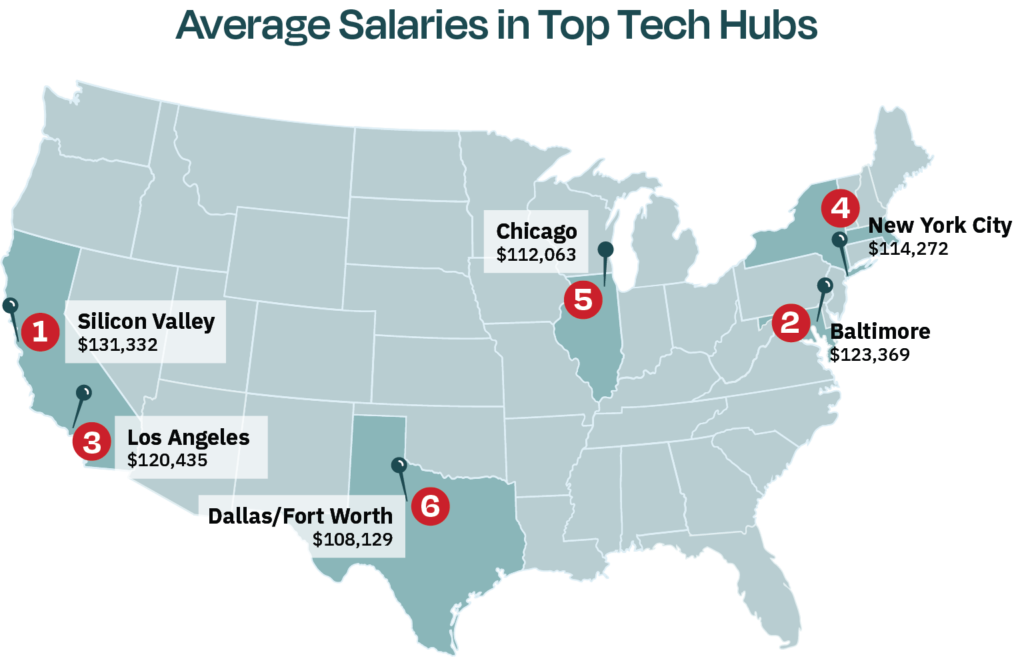
Silicon Valley maintained its tech salary dominance over other cities in 2024, even though it saw a 7.3% decline from last year. The Baltimore/Washington D.C. area saw the most growth at 5.8%, with Dallas/Fort Worth and Los Angeles gaining as well.

*Sample size less than 100 respondents, therefore not statistically valid. Presented for continuity purposes only.